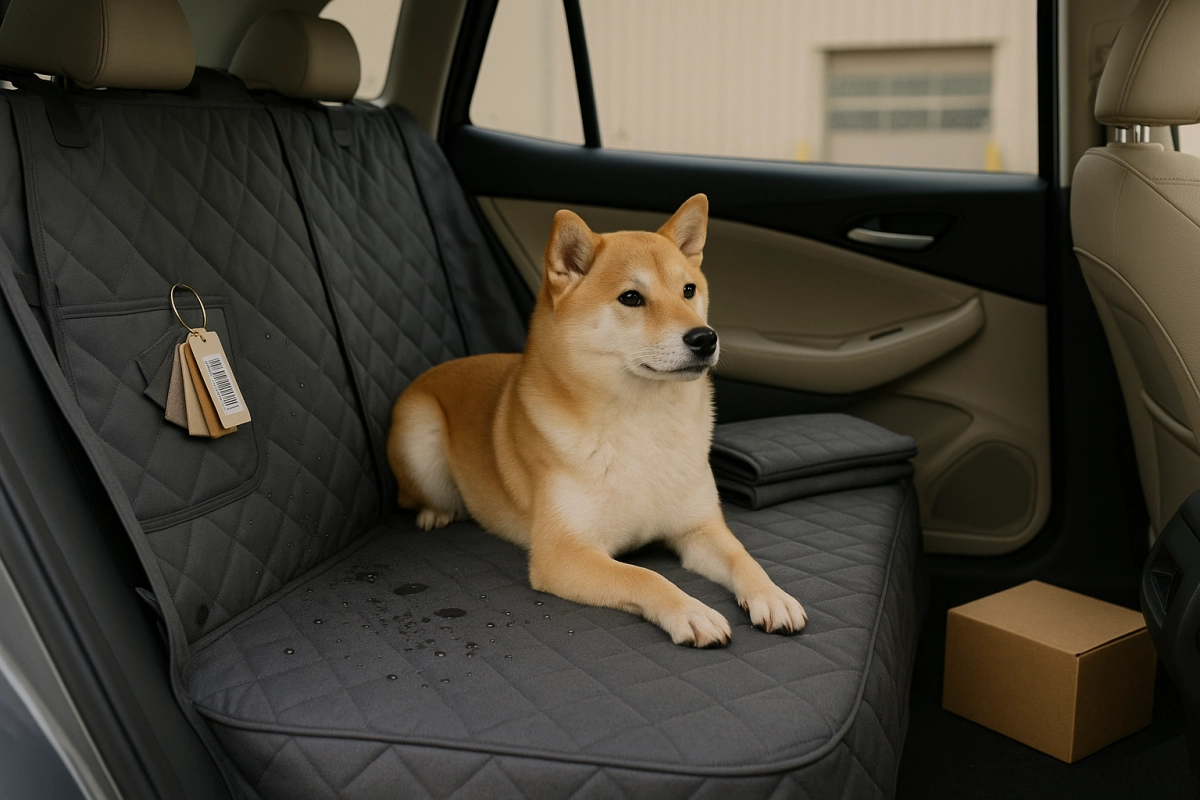
Pet travel went from “occasional” to “every week.” Guardians book taxi rides to the vet, stack weekend trips onto business travel, and shuttle dogs to daycare between errands. In that world, the humble dog blanket for the car back seat isn’t a throwaway accessory—it’s a protection system for interiors and a comfort system for animals, with real upside for merchants who get the details right. This guide distills the product decisions, fit logic, safety cues, and merchandising tactics that turn a simple cover into a dependable category with repeat purchases and solid margins. Many shoppers use different search phrases for the same need—dog blanket for car back seat, custom dog car seat covers, custom dog car seat—so your content and assortment should educate first and capture that intent without confusing the buyer.
1) The Job to Be Done (and Why This Category Converts)
A back-seat dog blanket has two equal jobs:
-
Protect the vehicle. Claws, sand, drool, and wet fur can chew through resale value. Leather and fabric both stain and scratch; a cover preserves surfaces and keeps trade-in photos honest.
-
Stabilize the ride for the dog. Slippery upholstery and sudden turns create “splay and slide,” which spikes anxiety and car sickness. The right surface gives traction, warmth, and a predictable perch.
From a business lens, this SKU punches above its weight:
-
It bundles naturally (seat-belt tether, door protectors, buckle guards, booster for small dogs).
-
It creates repeatable sales (spare liners, seasonal fabric, travel kits).
-
It signals quality across your catalog (stitching, lamination integrity, hardware).
2) Design Pillars: What Buyers Actually Feel in 30 Seconds
2.1 Surface & Padding
-
Top fabric. Choose a tightly woven, abrasion-resistant face (e.g., 600D polyester or durable twill) that resists snags and hair embedment.
-
Quilt & loft. Light quilting (120–200 gsm batting) adds comfort without turning corners into a sliding pillow. Dogs should feel cushioned, not surf on fluff.
-
Traction. A micro-textured face or siliconized print reduces slip when the driver brakes.
2.2 Waterproofing That Actually Works
-
Membrane, not just spray. Durable waterproofing comes from a TPU or PU membrane laminated beneath the face fabric, not a surface spray that washes out.
-
Seam discipline. Stitch lines can become leak paths; use seam bindings or hidden channels above the membrane to keep puddles from finding the foam.
2.3 Anti-Slip Underside & Anchors
-
Back coating. A dotted or honeycomb non-slip backing grips fabric and leather alike without leaving residue.
-
Seat anchors. Wedge-style foam anchors push into the seat crack to stop migration.
-
Headrest straps. Wide, bar-tacked webbing with side-release buckles avoids “string-saw” wear on leather.
2.4 Coverage Geometry
-
Bench vs. hammock. Bench covers protect the seat base and back; hammocks add two flaps that connect to the front headrests, creating a barrier and protecting the footwell.
-
Side flaps. Door-height side wings save bolsters from claw swipes during jumps.
-
Split seats. A 60/40 zipper lets you drop one section for a human passenger without unthreading the whole setup.
2.5 Access Points You’ll Be Grateful For
-
LATCH/ISOFIX and belt pass-throughs. Clean, bound openings let buckles emerge without fraying edges—or risky scissor mods by the customer.
-
Pocketing. Flat, meshless pockets hold wipes, poop bags, and a short tether; anything bulky becomes a dog pillow in the wrong place.
-
Buckle guards. Small neoprene sleeves stop hair and grit from packing into buckles.
3) Fit Without Returns: Sizing as a Service
Returns in this category are rarely “quality” and mostly “fit.” Convert uncertainty into confidence:
-
Measure what matters. Ask for rear bench width (door-to-door), seat depth (front edge to backrest), and seatback height. Publish your cover’s flat dimensions next to a visual silhouette.
-
State the edge cases. Compact crossovers have shallow benches; full-size SUVs have tall backs and aggressive bolsters. Name representative models or ranges (“fits most benches 125–145 cm wide”).
-
Split compatibility. If your zippers line up with typical 60/40 and 40/20/40 splits, say so. If not, offer a “universal offset” second zipper.
-
Headrest reality. Remind customers: removable headrests make life easier; for fixed posts, specify strap routing.
In-store hack: a cardboard “bench outline” on the floor lets shoppers try a quick fit check.
Online hack: three-question fit finder (vehicle class, bench width, headrest type) + a photo of the cover in sphinx and curled-up dog poses.
4) Safety & Comfort: What You Should—and Shouldn’t—Promise
-
Crash claims. Unless a system is paired with a crash-tested tether and harness and you hold valid documentation, do not imply crash performance. Write what you can defend: “Designed with pass-throughs for approved pet tethers; always secure dogs with a vehicle-rated harness.”
-
Airbag awareness. Side-curtain airbags generally deploy above door cards; ensure side flaps don’t interfere with airbag paths. Keep flaps soft, not armored.
-
Thermal comfort. Dark quilt can get hot in summer sun; recommend cracking windows or using sunshades. Light interiors may benefit from a mid-tone cover to avoid glare and heat.
-
Nausea minimization. Non-slip surfaces and hammock geometry reduce footwell tumbles—the first lines of defense against car sickness.
5) Materials That Photograph Well—and Wear Better
-
Face fabric. 600D polyester or a tough twill balances hand-feel with abrasion resistance. For a premium line, consider a canvas-look weave with a matte finish that hides fur and photographs beautifully.
-
Waterproof layer. TPU beats topical sprays for longevity and wash resilience. Avoid stiff PVC that cracks in cold weather.
-
Bindings. Nylon binding tape at edges keeps chew points from fraying.
-
Hardware. Acetal buckles tolerate temperature swings better than bargain polypro; metal cam buckles are overkill and can chip trim.
-
Colorfastness. Specify testing (e.g., AATCC crocking) and note “color transfer can occur on untreated leather when wet” to set expectations honestly.
6) Installation: A Step-by-Step that Prevents Support Tickets
-
Unpack & pre-fit. Unfold on the bench, quilt side up, anti-slip side down.
-
Anchor the base. Tuck seat anchors deep into the seat crack; press along the length to seat them.
-
Headrest straps (rear). Wrap straps around posts; snug, don’t strangle. Confirm buckles face away from the dog to reduce chewing temptation.
-
Hammock straps (front, if used). Clip to front headrests to create the hammock rise. Adjust until the “sag” protects the footwell without walling off the HVAC.
-
Pass-throughs. Thread buckles through the bound slits; close any Velcro covers to keep grit out.
-
Side flaps. Drape over bolsters or attach to door handles with soft loops if your design includes them.
-
Test with weight. Press a knee on the center and tug side-to-side; if the cover migrates, tighten anchors and straps.
7) Cleaning & Care: Publish the Real Routine
-
After messy trips. Shake outside first; fur comes off dry more easily than wet in a machine.
-
Machine wash. Cold, gentle cycle; mild detergent; no bleach or fabric softener (they defeat DWR and add slip).
-
Drying. Air-dry flat or tumble low without heat; high heat delaminates membranes and warps buckles.
-
Spot care. Enzymatic cleaner for organic mess, isopropyl wipe for sap or tar (test a hidden area).
-
Quarterly check. Inspect stitching at strap anchors and seat anchors; snip loose threads and melt tips lightly to prevent runs.
Offer spare liners as a dedicated SKU—dog families rotate covers like bed sheets.
8) Customization That Actually Sells (and Ships)
Private-label and branding can elevate a commodity. Keep custom levers practical:
-
Embroidery/print. Embroidery reads premium but can wick water at stitch holes—use a patch or apply above the membrane. For prints, heat-transfer logos sit cleanly on the face fabric.
-
Pattern & colorways. Offer a timeless neutral (graphite), a family-friendly mid-tone (stone/khaki), and one “editorial” color that photographs well.
-
Vehicle fit. Maintain a core “universal M/L” and add an “XL” for full-size trucks/SUVs.
-
MOQ & lead time. Publish real numbers and a rolling status cadence during peak seasons. Mixed-carton color splits make reorders sane for independents.
-
Packaging. Ship folded, not crushed; include a “reshape on unbox” card with light stuffing or steam tips.
9) Merchandising: PDP and In-Store That Convert Without Gimmicks
On the PDP
-
Hero photo in a real vehicle with a real dog (curled and seated “sphinx” poses).
-
Benefit bar: Waterproof Membrane • Non-Slip Base • Hammock Option • Machine Washable.
-
Use-case picker: City Errands / Road Trip / Multi-Dog / Kid + Dog.
-
Fit module with flat dimensions and a bench silhouette; “fits benches 125–145 cm wide.”
-
Install in 60 seconds: six icons mirroring the step-by-step above.
-
Bundles near Add-to-Cart: tether + buckle guards; door protectors; spare liner.
-
Care & warranty in one short, human paragraph.
In-store
-
Lay a sample across a demo bench. Let shoppers tug.
-
Provide a “Buy-Smart” pocket card: bench width, headrest style, split seat note, cleaning tips.
-
Hang a small placard: “Shake, wash cold, air-dry—membrane safe.”
10) Operations, QA & Compliance: Trust You Can Scale
-
Mechanical checks. Anchor pull test, buckle shear test, non-slip peel after heat/cold cycles, seam strength around pass-throughs.
-
Chemical compliance. Keep documentation for restricted substances on coatings, foams, and dyes in your target markets (e.g., Prop 65 disclosures where required).
-
Lot traceability. Batch labels enable surgical recalls instead of panicked scrubs—and customers remember transparency.
-
Sustainability that matters. Recycled-content face fabrics (state the percentage), repair kits (replacement anchors/buckles), and spare liners keep product in service longer.
11) Troubleshooting: The Honest FAQ to Publish
-
“It slides on leather.” Re-seat the anchors deep into the crack; tighten both headrest straps evenly; ensure the anti-slip side is down and free of dust.
-
“Dog chews the straps.” Flip buckles so they face away; consider a short tether that reduces reach; offer a chew-resistant strap upgrade in your premium line.
-
“Water leaked through stitching.” Liquid rode a needle line. Use a towel layer for heavy drenches; for next time, choose our seam-bound premium model.
-
“My seat heater?” Heaters under a waterproof layer can trap heat; recommend low settings and check frequently.
-
“Child seat + dog?” Route child-seat anchors through pass-throughs; never share a belt path with a pet tether.
12) The Buy-Smart Checklist (Shareable with Customers)
-
Waterproof membrane beneath a durable face fabric
-
Non-slip base + seat anchors + balanced headrest straps
-
Bench, hammock, and side-flap coverage options
-
Clean pass-throughs for belts and LATCH/ISOFIX
-
Machine-washable; air-dry safe; simple spot-care guidance
-
Split-seat compatibility and published flat dimensions
-
Honest claims on safety (no crash hype without data)
13) Why This Category Builds Brand Trust
Car interiors are personal; people remember the day mud didn’t ruin their seats and the dog didn’t tumble into the footwell. When your product quietly produces that outcome—paired with honest copy, real fit help, and a care routine that works—customers reward you with the second order: spare liners, door guards, cargo covers. That’s how a “blanket” turns into a dependable margin engine.
Conclusion: Protect the Bench, Calm the Dog, Respect the Buyer
A modern dog blanket for the back seat should be waterproof for real, stable underfoot, easy to fit, and easier to clean. Build the line around those truths; sort models by use case; show installation with clarity; include care cards; and keep customization practical. When you do, you won’t just sell a protective sheet—you’ll merchandise confidence, trip after trip.
0 Comments