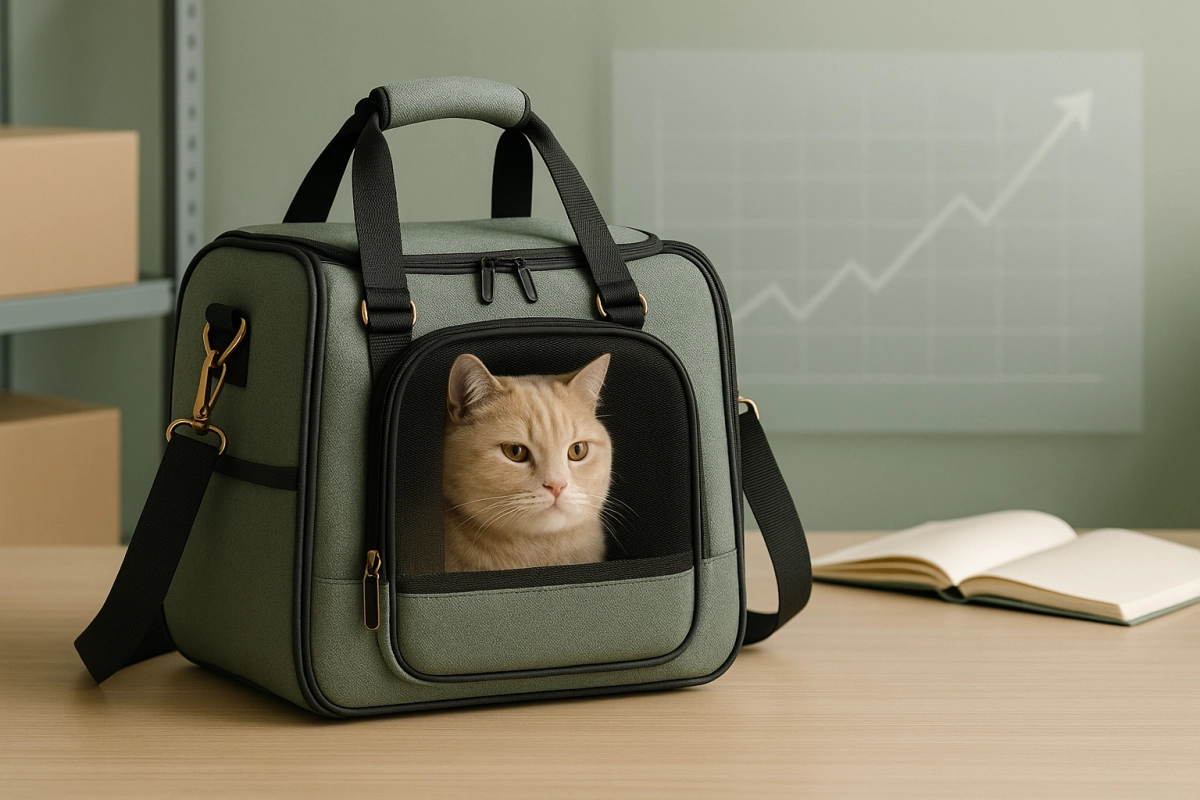
Pet mobility is no longer a niche; it’s everyday retail. Guardians book taxis to the vet, hop trains for grooming appointments, and add weekend trips to business travel. In that world, a well-designed cat carrying bag is more than a container—it’s a stress-reduction system for two nervous systems at once. When your assortment gets the fundamentals right—structure, ventilation, cleanability, sizing clarity, and honest guidance—you don’t just sell a bag. You build trust, reduce returns, and open add-on paths that raise lifetime value. And because shoppers search with different phrases—cat carrying bag, cat carry bags, wholesale cat crates—your content should educate first, capture that intent second, and never confuse the reader about what’s truly cat-appropriate.
1) The Job to Be Done (What Buyers Actually Feel)
A cat carrying bag should give a feline the sensation of a warm, steady, semi-private nook that happens to move. That means:
-
A stable floor that doesn’t bow as the cat shifts weight. If the base “tacos,” the cat braces and anxiety rises.
-
Forgiving sidewalls that keep shape without turning the bag into a rigid crate; a little compliance reduces bumps in transit and under-seat compression.
-
Adjustable visibility so timid cats aren’t on display in crowded spaces; guardians should be able to dial stimuli down.
-
Predictable handling so humans move smoothly through doors, stations, and car seats; calmer handling equals a calmer cat.
-
Cleanability that fits real households. If cleaning is hard, the carrier becomes closet clutter—and closet clutter never gets five-star reviews.
When those basics are right, the category punches above its weight in basket size. The core chassis invites practical bundles—spare pads, car tethers, rain covers—while education (fit guidance, onboarding) deflects the support tickets that erode margin.
2) Design Pillars You Can Defend in a Spec Sheet
If a claim can’t survive a procurement manager’s email, don’t make it. These are the build choices and copy lines that hold up under scrutiny.
Stable base, forgiving walls
Use a removable baseboard (EPE/EVA/PE wrapped in a soft sleeve). Publish thickness and a recommended pet-weight range. Internally, run “deflection under load” checks (e.g., a 6–7 kg sandbag should produce minimal bowing on the intended size). Sidewalls should spring back after compression; layered foams or ribbed inserts control sag.
Ventilation with discretion
More mesh isn’t always better. Pair a primary mesh window with secondary vents and a roll-down privacy flap. Guardians can increase airflow in summer, then lower visual input on busy sidewalks or in clinics.
Quiet, secure hardware
Covered zipper heads and fabric-wrapped buckles prevent the clacks that spike anxiety in taxis and trains. Auto-lock sliders stop “curious paw” escapes. A short internal tether clipped to a metal D-ring adds a last layer of security during hand-offs.
Human ergonomics
Balanced strap anchors keep the bag from pendulum-swinging into knees; a grippy handle matters on stairs; a luggage pass-through changes airport days from awkward to doable. None of this is cosmetic—good ergonomics literally calm the animal by stabilizing the ride.
Cleanability and odor management
Make pads removable and machine-washable. Seal interior seams so accidents don’t wick into foam. Publish care details plainly: wash temperature, cycle, drying guidance, zipper maintenance. Offer replacement pads: the rare upsell customers thank you for.
3) Fit Without Returns: Turn Sizing Into a Service
Most “quality issues” in this category are optimism issues. Help customers choose right the first time.
-
Measure what matters. Ask for body length (nose to base of tail) and standing shoulder height. Interior lying length should exceed body length by a few centimeters to allow curling and re-positioning.
-
Show the interior. A floor-plan silhouette plus photos of a cat in two real poses—curled and sphinx—beats paragraphs of specs.
-
Name the edge cases. If your M suits 4–6 kg domestic shorthairs but not Maine Coons, say so and link the reinforced variant with extended baseboard.
-
Temperament toggle. “Hider” cats often prefer less mesh and darker liners; “Curious” cats enjoy wider views if the base is rock-steady.
Store tactic: place a cardboard “size scout” template matching interior floor space. Shoppers decide in under a minute.
Online tactic: a three-question fit quiz (weight, body length, temperament) slashes exchanges and boosts post-purchase confidence.
4) Use Cases That Should Shape Your Line: City, Road, Air
City commute
Priorities: cross-body comfort, privacy flap, quiet hardware, and a luggage pass-through. At a brisk walking pace, the floor should remain roughly level and avoid knee collisions when the wearer turns.
Road trip
Add a seat-belt loop and a slightly firmer base. Side-entry access lets guardians check and reassure at rest stops without full extraction. Pockets for wipes and a collapsible bowl are small but meaningful quality-of-life wins.
Air travel (general guidance)
“Airline-friendly” is not a certification; it means soft sides that flex under most seats, quick top-load access at security, and a stable base once aboard. Provide a pre-flight checklist on your PDP and in post-purchase emails: verify under-seat dimensions vs. carrier size, pre-book the pet spot where required, line the pad, carry a spare, and choose a seat thoughtfully (window seats often feel calmer).
Aligning models to use cases keeps your price ladder honest and your return rate predictable.
5) Materials That Photograph Well and Wear Better
Exteriors
High-denier nylon or polyester with a discreet water-repellent finish handles rain and coffee alike. Vegan leather elevates aesthetics and wipes clean. Pebble-grain textures hide scuffs and look premium in lifestyle photography.
Interiors
Cats prefer warm, quiet, low-slip surfaces. Reversible pads—plush on one side, smooth knit on the other—extend seasonality. Choose liners that don’t “screech” under claws; micro-mink and brushed knits outperform tarpaulins for sound and comfort.
Mesh & windows
Specify tear-resistant mesh; round the zipper garages so paws can’t pry. If you add clear windows, use UV-stable TPU to prevent yellowing and micro-cracks over time.
Hardware & stitching
Metal D-rings at stress points; box-stitching on straps; bartacks where shoulder loads shift. A #5 or #8 coil zipper with auto-lock sliders balances glide and security without snagging soft liners.
6) Assortment Architecture: Good / Better / Best That Actually Means Something
-
Good (City Vet & Taxi). Sturdy base, modest mesh + privacy flap, shoulder carry, luggage pass-through, washable pad. The dependable everyday choice.
-
Better (Road-Trip Max). More mesh with smart vent routing, optional backpack conversion, seat-belt loop, rain cover, extra pockets.
-
Best (Style-Forward Premium). Refined exterior (vegan leather/pebble-grain), brushed hardware, magnetic privacy flap, memory-foam base pad, optional monogram.
Say the trade-offs out loud: stiffer shells photograph crisply but flex less; ultra-light shells are a joy to carry but need reinforcement for heavier cats. Clarity converts—and inoculates reviews.
7) PDP Structure That Answers Questions in the Order Shoppers Think
-
Real-life hero shot (cross-body in an urban setting).
-
Benefit bar: Stable Floor • Privacy Flap • Airline-Friendly • Washable Pad.
-
Use-case picker: City / Road Trip / Airline.
-
Fit & size module: interior silhouette + curled & sphinx photos per size.
-
Materials callouts: short, specific bullets (outer fabric, liner, mesh, hardware).
-
Onboarding playbook: the six-step routine (below) rendered as icons + one-line tips.
-
Smart bundles: spare pad + car tether; rain cover + reflective strap—place near Add-to-Cart, not buried below reviews.
-
Care & replacements: a link to spare pads and a zipper-care note.
-
UGC reel: 10–15 second clips of calm entries beat studio spins because they solve the real fear—“Will my cat accept this?”
This structure reduces cognitive load and makes your brand feel organized and trustworthy.
8) Behavior-First Onboarding: The Six-Step Routine You Should Publish
-
Open-Door (Days 1–2). Carrier in a quiet room, door open, familiar blanket inside. No zipping, no pressure.
-
Treat Trails (Days 3–4). Place small treats or a lickable snack inside. Reward approach.
-
Micro-Closes (Days 5–6). Zip for 10–30 seconds while feeding through mesh; reopen and praise; repeat.
-
Add Motion (Day 7). Slow loop around the room. If eyes go wide or breathing quickens, stop and regress one step.
-
First Drive. Seat-belt the bag; keep it under five minutes; aim for a calm rep, not an errand.
-
Keep Visible. Store the carrier in sight so it becomes furniture, not a bad omen.
If distress persists (panting, drooling, prolonged vocalization), advise pausing training and consulting a veterinarian. Some households do well with pheromone-primed liners 30–60 minutes before travel—offer the suggestion, not a promise.
9) Retail & Showroom Tactics That Lift AOV Without Gimmicks
-
Three-frame story. Cat steps in at home → privacy flap down in a rideshare → relaxed in the clinic lobby. This quiet arc says: calm here, calm en route, calm there.
-
Touch & compare. Let shoppers feel the difference between Core and Reinforced baseboards.
-
Checklist handout. A “Buy-Smart” card at shelf: base stability, privacy flap, auto-lock zippers, luggage pass-through, washable pad.
-
Sustainability that matters. Repair kits (zipper pulls, baseboards) and cross-season liner compatibility beat vague “eco” claims every time.
10) Wholesale & Ops: Make It Easy to Stock—and Reorder
-
SKU hygiene. Three models × two sizes × two colors keeps assortment clear and turns healthy.
-
MOQ logic. Align minimums with actual color demand; avoid over-indexing on slow hues.
-
Lead-time buffers. Publish a transparent range; in peak seasons (summer travel, year-end holidays), send weekly updates.
-
Packaging. Ship flat without hard creases; include a “reshape on unbox” card (gentle stuffing/steaming tips).
-
Docs. A one-page spec & care sheet in every carton—cheap to print, priceless for customer-service deflection.
11) Compliance, QA, and Traceability (Trust That Scales)
-
Chemical safety. Keep documentation for restricted substances on coated fabrics, foams, and adhesives in your target markets. Avoid vague “eco-friendly”—state recycled content by percentage when used.
-
Mechanical checks. Baseboard deflection under weighted load; strap-anchor pull; zipper float under tension; mesh tear resistance.
-
Lot codes. Label batches so any issue can be isolated quickly. Customers forgive mistakes faster than opacity.
12) Troubleshooting: The Honest FAQ You Should Publish
-
“My cat cries when zipped.” Return to micro-closes; lower the privacy flap; consider a pheromone-primed liner; if distress persists, consult a vet.
-
“The side bowed in.” Re-check baseboard orientation; for heavier cats, pick the reinforced variant.
-
“Overheating in summer.” Flip to the smooth liner, open secondary vents, and travel at cooler hours.
-
“Clawing at mesh.” Use tear-resistant mesh and rounded zipper garages; keep sessions short until acceptance improves.
13) Sustainability That Helps Customers and Margins
Real sustainability is modularity. Offer spare pads, replacement zipper pulls, and replacement baseboards. Keep liners cross-compatible across model years. Customers replace a part, not the whole, and become advocates.
14) Conclusion: Make Calm Portable—and Make It Obvious
A great cat carrying bag respects a cat’s need for a steady, padded, semi-private space and a human’s need for an object that behaves well in the real world. Build around structure, ventilation, cleanability, sizing clarity, and a simple onboarding routine. Sort your line by use case, not internal codes. Put replacement pads one click away. Do this consistently and you transform a single SKU into a category that compounds margin—and goodwill.
About the Author & Review Process
This guide was written by a pet-travel product specialist with 10+ years advising brands, veterinary clinics, and independent stores on carrier design, sizing systems, QA, and post-purchase education. Drafts were peer-reviewed by a feline behavior consultant and a soft-goods QA lead to validate handling, onboarding, and durability recommendations. Guidance here is educational, not medical; for pet-specific health or behavior concerns, consult a licensed veterinarian.
0 Comments