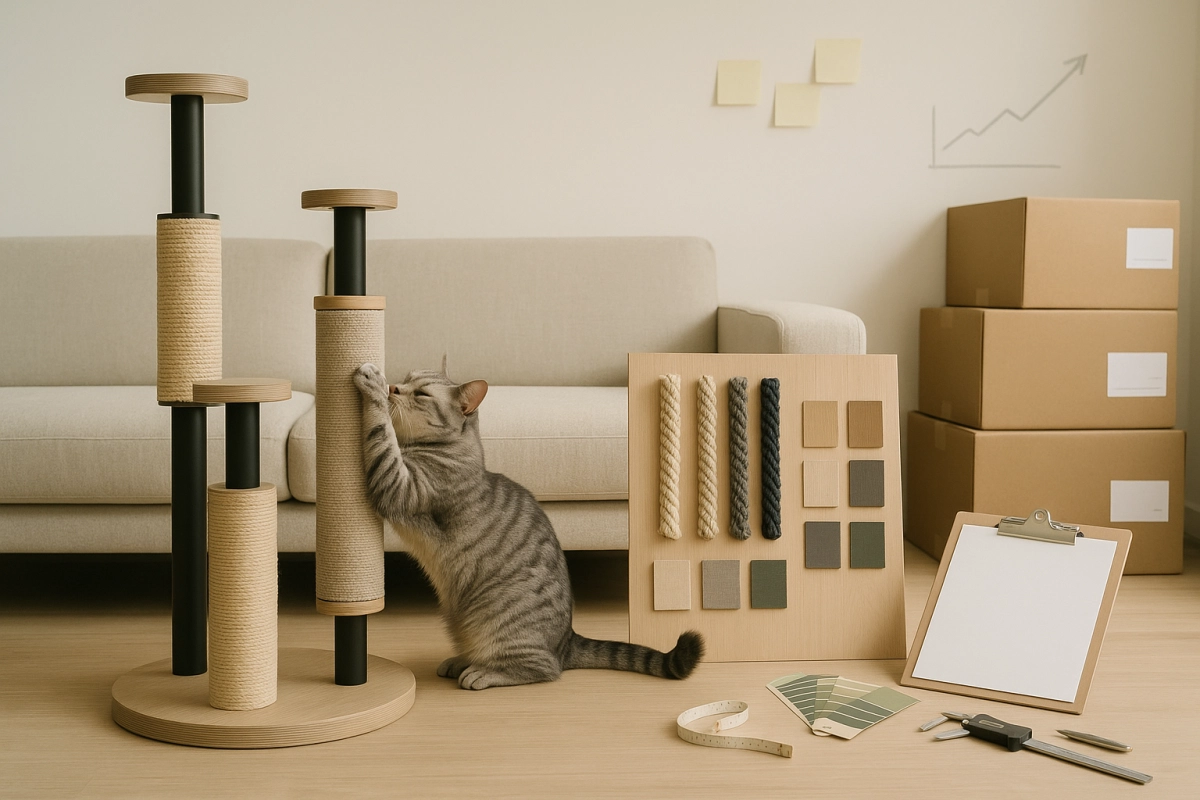
Cats scratch for three reasons that matter to your margins: to stretch the spine and shoulders, to shed nail sheaths, and to mark territory (yes, there’s scent in those paw pads). When you design and merchandise a scratching assortment around those behaviors—not just around pretty photos—you replace customer frustration with repeatable delight. For retailers, DTC brands, and distributors, a thoughtful custom program does more than protect sofas; it lowers returns, anchors add-on sales (refill sleeves, wall mounts, catnip), and quietly signals that your brand understands real life with cats.
If you’re scoping a category reset or a new line, this guide shows the decisions that actually move the needle—from base physics and abrasive materials to packaging geometry and post-purchase education. And if your sourcing brief includes phrases like custom cat scratching post, custom made cat scratching posts, bulk cat scratchers, you’re in exactly the right place.
1) What “Good” Feels Like to Cats (and Why That Sells)
A product wins when the cat prefers it over the sofa, every time. That means:
-
Height you can reach and lean into: most adult cats want a full, head-above-shoulder stretch. If they must crouch, they’ll defect to the couch arm.
-
Stability that never wobbles: the first scary tilt becomes a permanent “nope.”
-
Texture that rewards claw engagement: enough bite to catch a sheath, not so coarse that it snags and startles.
-
Orientation choice: vertical for big stretches; horizontal for claw maintenance sprints; angled for senior cats and kittens.
-
Placement logic: near sleeping spots (post-nap stretch), near doorways (territory), and near forbidden targets (sofa arms, doorway trim).
When you engineer for these moments, reviews turn from “didn’t use it” into “used it on day one,” which reduces CS tickets and drives word-of-mouth.
2) Design Pillars You Can Defend in a Spec Sheet
2.1 Height, Diameter, and the Anti-Topple Triangle
-
Post height: 70–90 cm serves most adults; add a 100–110 cm hero SKU for large breeds and athletic households.
-
Post diameter: 10–12 cm prevents “spin” under load; 14 cm feels luxurious and quiets vibration.
-
Base physics: as a rule of thumb, base width ≥ 0.35× post height; add mass at the base (hidden steel plate or dense MDF) so center of gravity stays low.
-
Tilt test: with 6–7 kg lateral force applied at top, the product must not tip. Publish this in QA notes; buyers love quant.
2.2 Abrasive Media: Rope, Fabric, and Cardboard (When Each Wins)
-
Woven sisal fabric (not rope) delivers a uniform, loud “reward” sound and sheds less fuzz. It’s the conversion king for couch-addicted cats.
-
Sisal rope (3–4 mm) is classic and repairable; specify tight wrap, no gaps, and a hidden staple line. Offer rope sleeves as refill SKUs.
-
Corrugated cardboard (A/B flute) drives budget volume and subscription refills; design for tool-less swaps and clean recycling.
-
Carpet is polarizing; many cats ignore loop pile and it can snag claws. If used, pick tight, cut-pile with high abrasion rating and low snag index.
2.3 Cores, Adhesives, and VOCs (The Invisible Trust Builders)
-
Cores: solid wood looks premium; MDF is flatter for fabric wraps but watch formaldehyde specs.
-
Adhesives: water-based PVA or hot-melt with low odor; publish VOC claims honestly (and back them in testing).
-
Edge finishing: wrap and tuck edges under trim channels; exposed cut edges invite picking and early failure.
2.4 Sound, Feel, and Reward
-
The first 10 scratches must “talk back.” Woven sisal’s rasp gives instant feedback; rope creaks are quieter but satisfying.
-
Micro-vibration dampers under the base (rubber feet) make the strike feel solid and protect floors.
2.5 Repairability and Modularity
-
Make sleeves replaceable. A refillable column creates lifetime value and loyalty.
-
Bolt-on heads (perches, teaser mounts) let buyers upgrade without replacing the base.
-
Standardize fasteners across SKUs to simplify spare-part logistics.
3) Assortment Architecture: Good / Better / Best That Actually Means Something
-
Good (Apartment Core): 75 cm fabric-wrapped post, 30–35 cm weighted base, rubber feet, starter catnip, tool-less assembly.
-
Better (Family Upgrade): 85–95 cm post, wider base, woven sisal fabric with vertical seam guard, bolt-on toy mount, rope-sleeve refill compatibility.
-
Best (Design + Durability): 100–110 cm, 14 cm diameter, hidden steel plate, premium woven sisal, upholstered base edge, magnetic teaser mount, color stories to match interiors.
Cross-merch horizontal scratchers (under coffee tables) and wedge ramps (for senior cats). Put a wall-mount strip in the line for the “I live in 45 m²” customer.
4) Customization That Sells (and Ships)
Your brand levers should be beautiful for customers and boring for operations.
-
Color stories: warm neutral (greige), cool neutral (graphite), one editorial color per season.
-
Textile choice: woven sisal in natural and “dyed-but-not-loud” tones; dye lots must be repeatable.
-
Branding: debossed leatherette tab or minimal print at base edge; avoid giant logos where cats scratch—it wears poorly and looks cheap.
-
Dimensions: hold a universal footprint for carton efficiency; offer height/diameter variants off the same base.
-
Packaging: flat pack that assembles in under 5 minutes with one tool; include a QR video.
-
Insert: a one-page “first scratches in 48 hours” guide (see onboarding section) and a refill reminder card with QR to spare parts.
5) Procurement Reality: MOQs, Lead Times, and Cost You Can Defend
-
MOQs: think in colorways, not just units. A 3× color split keeps floor sets fresh without stranding inventory.
-
Lead times: set honest windows (fabric dyeing adds days); confirm up-front the test plan for VOCs, formaldehyde (for MDF), colorfastness, and abrasion.
-
Cost drivers: sisal fabric > rope > cardboard; steel plate adds perceived quality and real stability—worth the BOM in Best tier.
-
Carton geometry: protect the base corners; cube efficiency matters more than you think once you ship nationally.
-
Drop tests: spec a 6-side, 1-edge, 1-corner drop protocol; post columns hate corner crush.
-
Spares: stock sleeves and hardware kits; a $6 part can save a $60 return.
6) Quality & Compliance: The Boring Bits That Prevent 1-Star Reviews
-
Mechanical: tilt/torque at top, fastener pull-out, seam tear strength, rope unwind resistance (turns per meter + tack force).
-
Chemical: adhesives and finishes below your market’s VOC thresholds; MDF formaldehyde class compliance; azo dye restrictions for colored sisal.
-
Odor: “out-of-box” sniff test; cats reject strong factory smells.
-
Floor safety: stain transfer checks on unfinished wood and light vinyl.
-
Traceability: batch labels on base plates; QR to an online care page and parts ordering.
7) Onboarding: How to Win the First 48 Hours (and Save a Sofa)
Place the post where the cat already scratches (next to the sofa arm), not where you wish it would. Then:
-
Prime the fabric lightly with catnip or silvervine (or rub with the cat’s blanket).
-
Reward any investigation: treats when paws touch the post, not after the cat leaves.
-
Move forbidden targets: cover sofa arms temporarily; the post must be the better billboard.
-
Demonstrate scratching (use a wand toy to guide paws up the post); don’t drag claws by hand.
-
Praise the first “rasp” loudly, then leave the room. Cats own spaces when we stop fussing.
-
After three days of success, relocate secondary posts to sleep and doorway zones.
Print this routine on an insert. Education turns “my cat ignored it” into “worked day one.”
8) Merchandising: PDPs and Shelves That Convert Without Gimmicks
Online:
-
Hero photo: cat mid-stretch (sphinx and full-reach shots), human-scale context (sofa, doorway).
-
Benefit bar: Stable Base • Real Sisal Fabric • Replaceable Sleeve • 5-Minute Assembly.
-
15-second video: the first scratch sound, not a silent spin.
-
Fit module: height/diameter chart with “cat height to shoulder” guidance.
-
Parts tab: sleeves, toys, hardware kits; one-click add with the main SKU.
-
Reviews prompt: “Where did you place it? Day 1 result?”—harvest practical tips.
In-store:
-
Let shoppers rock the post—stability sells.
-
Side-by-side fabric vs rope swatch wall; invite touch.
-
“Buy-smart” card: height guide, placement map, onboarding steps, QR to video.
9) Sustainability That Helps Cats, Customers, and Costs
-
Refillable design: sleeves and rope rewinds extend life and margin.
-
Honest materials: recycled corrugate for cardboard SKUs, FSC options for wood, water-based adhesives where performance allows.
-
Repair kits: spare feet, caps, fasteners—small parts keep big things out of landfills.
-
End-of-life: communicate how to separate textile, core, and metal for local recycling streams.
10) Troubleshooting: The Honest FAQ You Should Publish
-
“Cat ignores the post.” Move it next to the target scratch zone; prime with silvervine; make the first scratch happen with a wand toy.
-
“Post wobbles.” Verify fasteners, check base on level floor, add the included steel weight (Better/Best).
-
“Snagged claw.” Switch to woven sisal fabric; carpet loops can catch. Trim loose fibers with scissors.
-
“Rope unwinding.” Re-tack with included pins or replace sleeve; ensure rope wrap direction matches the anchor.
-
“Strong smell.” Air out 24 hours; if odor persists, contact support for sleeve replacement—cats veto strong scents.
11) The Buy-Smart Checklist (Share With Customers)
-
Full-stretch height matched to your cat’s shoulder height
-
Stable, weighted base with anti-slip feet
-
Woven sisal fabric or tight sisal rope; replaceable sleeve design
-
Clean seams and hidden staples (no snag points)
-
5-minute tool-light assembly; clear spare-parts path
-
Placement guide and onboarding steps in the box
12) Why This Category Builds Trust (and AOV)
A sofa saved is a testimonial earned. When your post feels stable, sounds right, and comes with a simple plan that works in two days, customers forgive minor blemishes, buy refills, and gift a second unit for the hallway. That’s how a “stick and base” turns into a durable margin engine—and how your brand earns the second order without shouting.
Conclusion: Make Scratching Inevitable—and Make It Obvious
Design for feline biomechanics, ship with human-friendly assembly, and teach the first 48 hours like it’s part of the product (because it is). Keep your assortment simple but meaningful; make refill paths obvious; and publish the tests that prove you sweat the details. Do this, and your custom scratching program won’t just protect furniture—it will become the quiet hero of your pet category.
0 Comments